
Your Professional LCD Module Manufacturer
Introduction to the composition of tft lcd module
Release time:
2022-11-16 11:18
Source:
The tft lcd module is simply a screen + backlight component. The display part of the LCD TV is the liquid crystal module, which is equivalent to the picture tube in the CRT. Other parts include power supply circuits, signal processing circuits, etc., and of course the casing. The tft lcd module is mainly divided into screen and backlight components. The two parts are assembled together, but work independently of each other (i.e. the circuits are not related).
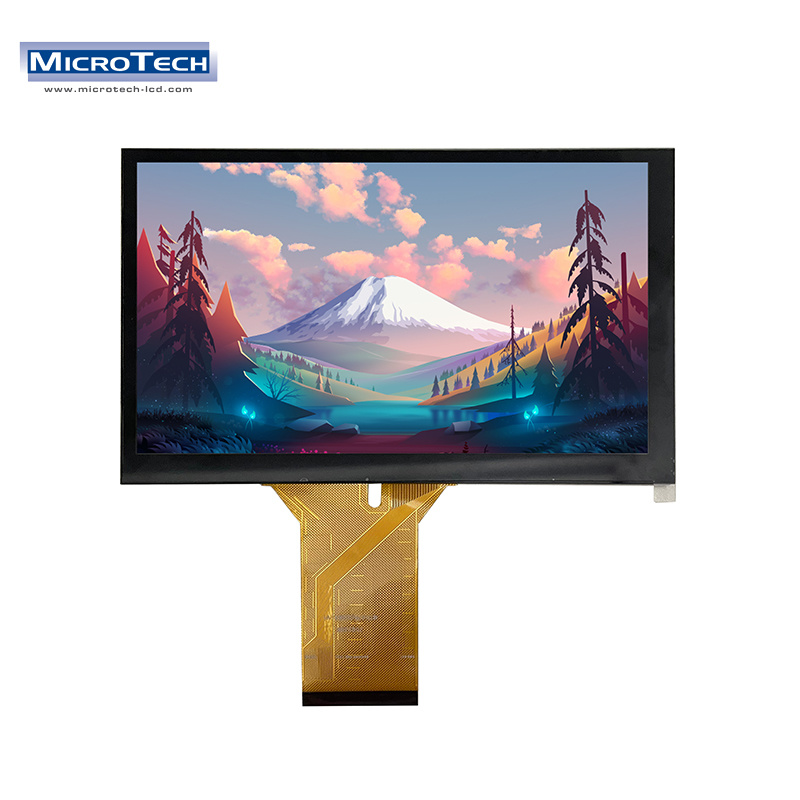
Composition of tft lcd module:
1. Polarizer: It is mainly used as a grating, which only allows light in a single direction to pass through, and can also protect the CF layer and the TFT layer.
2. CF layer and TFT layer: one up and one down to form an electric field, so that the liquid crystals are arranged under this electric field.
3. Alignment (PI) film: Alignment film has directional properties to allow liquid crystals to be arranged regularly on the alignment film.
4. Transparent metal conductive layer (ITO): electrify the upper and lower glass to control the direction of the liquid crystal.
5. Frame glue: Just like the walls of the house, it is used to prevent the liquid crystal from contacting the outside world.
6. SPACER: Just like the pillars of the house, it is used to support the upper and lower substrates.
7. Liquid crystals: Control the arrangement of liquid crystals under different electric fields, and use the amount of light with different transmittances to achieve the display principle.
8. Backlight module: Provide a backlight to display the signal changes of the LCD.
Applications of tft lcd module: power measurement and control terminal, injection molding machine computer, numerical control system, man-machine interface, medical equipment, biochemical analysis, textile machinery control, tax control machine, lottery ticket machine, food testing, chromatographic analysis, electronic measurement, environmental experimental equipment , fire safety, automotive electronics and data acquisition and other fields.
preceding page
next page
Featured Articles
The Difference Between IPS and TN Displays
IPS (In-Plane Switching) and TN (Twisted Nematic) are the two most common technologies currently used in liquid crystal displays. Each has its own strengths and weaknesses, and below I will detail the differences between them.
The Next Generation of Displays: Capacitive Touch Panels
Explore the innovative world of capacitive touch panels and how they are revolutionizing the consumer electronics industry. Learn about the benefits, features, and applications of these cutting-edge d
All You Need to Know About Graphic LCD Modules
Explore the world of graphic LCD modules in the consumer electronics industry, specifically in the realm of LCD display modules. Learn about the features, benefits, and applications of graphic LCD mod
Revamp Your Display Experience with Capacitive Touch Panels
Enhance your viewing experience with the latest technology in display panels - capacitive touch screens. Learn how these advanced panels can revolutionize the way you interact with your devices and ta
Microtech
Microtech Technology Company Limited established in 2001,offers professional design and manufacturing services for hundreds types of Liquid Crytal Display modules and Touch Panels-TN,FSTN,TFT,RTP,CTP.


