
Your Professional LCD Module Manufacturer
Two touch forms of capacitive touch panel products
Release time:
2021-09-29 16:39
Source:
Generally, capacitive touch panel products are coated with a layer of antimony tin oxide film (ato layer) and protective film (hard coat layer) on the surface of transparent glass, while the LCD monitor (LCD monitor) needs to be treated with electronic signal interference prevention (shielded layer).
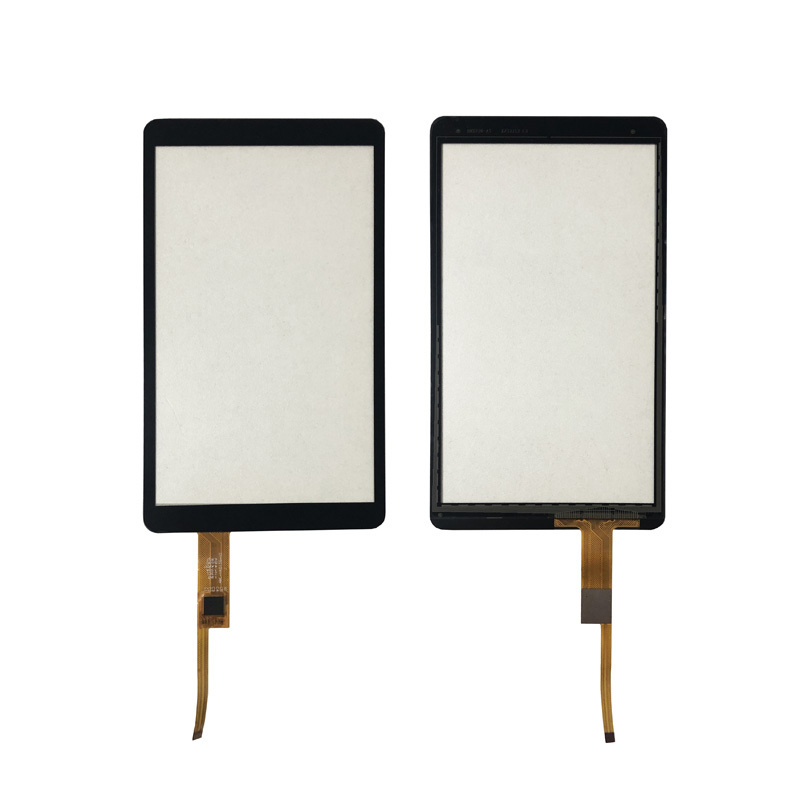
The capacitive touch panel manufacturer tells you that when a person is not in contact with the touch panel, the various electrodes are at the same potential, and there is no electric current passing through the touch panel. When it comes into contact with the touch panel, the static electricity in the human body flows into the ground and generates a weak current to pass through. The detection electrode changes according to the current value, and the contact position can be calculated. The capacitive touch panel manufacturer tells you that the antimony tin oxide film (ato) layer on the glass surface has a resistivity. In order to obtain the same electric field, electrodes are installed around it, and the current is input from four sides or four corners.
The capacitive touch panel manufacturer tells you that when inputting from 4 sides, the electric field is obtained by the resistance distribution method around the 4 corners is less than the impedance on the 4 sides. For practical applications, there is a type of mounting a set of resistive substrates on a transparent conductive film (ato layer); there are also types of etching the transparent conductive film (ato layer). When inputting from 4 angles, the equal electric field is generally obtained by combining the frontal edge resistance of printing and the transparent conductive film (ato layer). The capacitive touch panel manufacturer tells you that when inputting from the 4 sides, it can be calculated according to the current ratio of the top and bottom and the left and right, and the detection method is relatively simple. When inputting from 4 corners, the detection method has to get the distance ratio to the 4 sides, and the position calculation is also more complicated.
Featured Articles
The Difference Between IPS and TN Displays
IPS (In-Plane Switching) and TN (Twisted Nematic) are the two most common technologies currently used in liquid crystal displays. Each has its own strengths and weaknesses, and below I will detail the differences between them.
The Next Generation of Displays: Capacitive Touch Panels
Explore the innovative world of capacitive touch panels and how they are revolutionizing the consumer electronics industry. Learn about the benefits, features, and applications of these cutting-edge d
All You Need to Know About Graphic LCD Modules
Explore the world of graphic LCD modules in the consumer electronics industry, specifically in the realm of LCD display modules. Learn about the features, benefits, and applications of graphic LCD mod
Revamp Your Display Experience with Capacitive Touch Panels
Enhance your viewing experience with the latest technology in display panels - capacitive touch screens. Learn how these advanced panels can revolutionize the way you interact with your devices and ta
Microtech
Microtech Technology Company Limited established in 2001,offers professional design and manufacturing services for hundreds types of Liquid Crytal Display modules and Touch Panels-TN,FSTN,TFT,RTP,CTP.


